
From March 15–17, Tharu women farmers in Bardiya District, south-western Nepal, stepped into a new role—not just as farmers, but as leaders in renewable energy use within their communities.
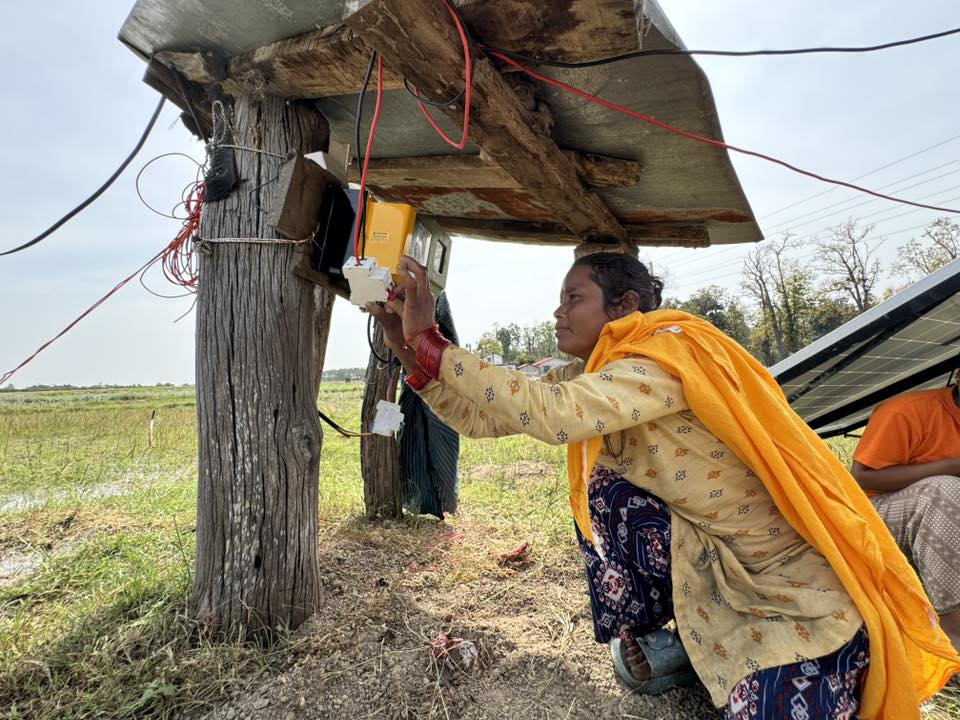
Under Phase 4 of the Community-based Renewable Energy Project (CbREP), CEMSOJ, in partnership with the Tharu Women’s Upliftment Center (TWUC), distributed four solar irrigation pumps and conducted practical orientation sessions with women’s farmer groups.
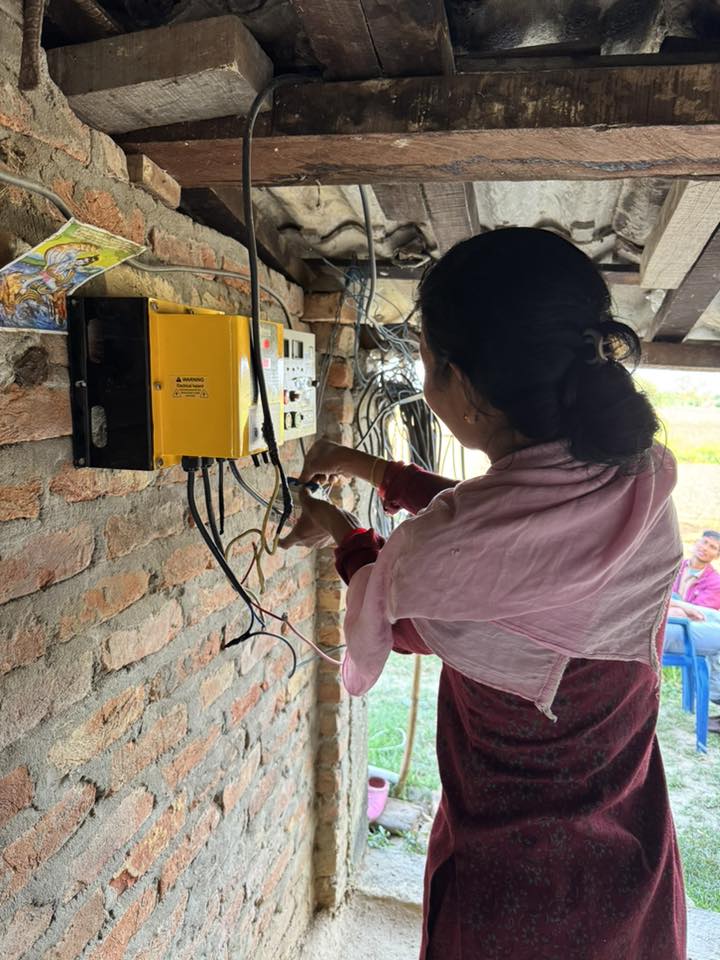
This initiative places women at the center of energy access, decision-making, and use—demonstrating how renewable energy can directly support livelihoods when led by communities themselves.
Women Managing Energy for Agriculture
The solar irrigation pumps were handed over to women-led groups:
- Bebari Women Farmer’s Group, Ward 10, Gulariya Municipality
- Upahar Women Farmer’s Group, Kothiya (Ward 8, Gulariya Municipality)
- Milan Women Farmer’s Group, Ward 4, Madhuwan Municipality
- Indigenous Ferawa Women Farmer’s Group, Ward 4, Madhuwan Municipality
With solar-powered systems, women farmers now have reliable access to water for irrigation—reducing dependence on fuel, lowering operational costs, and enabling more consistent agricultural production.
TWUC is continuing the rollout, with additional pumps and training sessions planned for more groups in the coming days.
REP’s Ripple Effect
Many of the women and facilitators involved in this activity have been part of earlier learning processes under the Indigenous Peoples Renewable Energy Pathfinders (IPREP) and the interlearning exchange in Sabah, Malaysia late 2025.
What is now visible is a shift—from participation in training spaces to leadership in real-world application.
Women are not only using renewable energy technologies; they are organizing around them, managing their use, and shaping how they support community livelihoods.
This initiative highlights that access to renewable energy is not only about availability but also about leadership and beneficiaries. By prioritizing women, the project fosters enhanced economic independence, more robust collective action among women’s groups, and improved resilience within local food systems.
Supported by the Pawanka Fund and facilitated through AIPNEE and the Right Energy Partnership with Indigenous Peoples (REP), it reflects a broader commitment to ensuring that energy transitions are inclusive, practical, and community-led.
🔗 More photos: https://www.facebook.com/story.php?story_fbid=1406732171491342&id=100064637171704&rdid=sWeLqFIzF9pSAO8w
0 Comments
Trackbacks/Pingbacks